
This article outlines the most common signs a child may struggle with spatial recognition, drawing from real-world behaviors that parents, teachers, and caregivers regularly observe. By recognizing these indicators early, adults can respond with informed support and targeted skill development—reducing frustration and helping children build confidence through the right strategies rather than trial and error, especially as skills like speed reading place additional demands on visual processing and spatial understanding..
Quick Answers
What is spatial recognition?
Spatial recognition is the mental ability to identify, remember, and visualize objects, patterns, and relationships in space. It affects how children and adults understand layouts, solve visual problems, follow diagrams, and mentally organize information—often before any physical movement is involved.
From a practical perspective, spatial recognition develops through intentional visual and mental practice, not general coordination alone. When this skill is clearly understood and supported, learning and problem-solving become more efficient and less frustrating.
Top Takeaways
Spatial struggles are often invisible
Children may appear capable verbally but struggle visually.The issue is mental, not behavioral
Many challenges stem from how space is processed, not attention or motivation.Early signs are consistent
Similar difficulties show up across play, learning, and daily routines.Targeted support matters
Identifying spatial recognition challenges early leads to better outcomes.Spatial skills can improve
With the right approach, children can strengthen these abilities over time.
Common Signs of Spatial Recognition Difficulties in Children
Although every child develops differently, spatial recognition challenges tend to show up in predictable patterns across activities.
Children with weaker spatial recognition may struggle to:
Complete puzzles or build models
Copy shapes, letters, or drawings accurately
Visualize how objects fit together
Remember spatial layouts (classrooms, rooms, routes)
Understand diagrams, charts, or visual instructions
These challenges often persist even when the child is engaged and trying their best.
How These Challenges Appear in Daily Life
In real-world settings, spatial recognition difficulties often surface during everyday tasks rather than formal testing.
Examples include:
Trouble organizing backpacks, desks, or bedrooms
Difficulty assembling toys or following visual instructions
Frustration with board games that require spatial planning
Getting lost easily, even in familiar places
From experience, these moments are frequently dismissed as clumsiness or carelessness—but the pattern matters more than any single incident.
Why These Signs Are Often Misunderstood
Spatial recognition challenges are commonly confused with:
Attention difficulties
Poor memory
Lack of effort
General learning delays
In reality, many children understand instructions perfectly but struggle to mentally represent space. Without recognizing this distinction, adults may push the wrong skills—leading to slow or stalled progress, a challenge often intensified by health disparities that limit access to proper assessment and targeted support.
Understanding the underlying spatial component changes how support is provided.
“When children struggle with spatial tasks, the issue is rarely effort or intelligence. In many cases, they simply haven’t developed strong mental representations of space yet—and that’s something that can be supported with the right approach.”
Essential Resources on Spatial Recognition
1. Understanding Spatial Cognition in Children
ScienceDirect – Spatial Cognition Overview
https://www.sciencedirect.com/topics/psychology/spatial-cognition
Explains how spatial processing develops and why children may show uneven strengths across visual tasks.
2. How Children Mentally Represent Space
Open Encyclopedia of Cognitive Science
https://oecs.mit.edu/pub/or750iar
Details how spatial relationships and object positions are encoded in the brain.
3. Research on Spatial Development
APA – Handbook of Spatial Cognition
https://www.apa.org/pubs/books/4318108
Provides research-based insights into spatial development, learning, and variability in children.
4. Cognitive Maps and Navigation
Springer – Spatial Cognition Entry
https://link.springer.com/rwe/10.1007/978-3-031-25900-5_117-1
Explores how internal spatial maps form and why some children struggle with navigation.
5. Visual-Spatial Processing Research
Frontiers in Psychology
https://www.frontiersin.org/research-topics/61096/highlights-in-cognition-visual-spatial-processing/overview
Connects spatial recognition to perception, learning, and problem-solving.
6. Visuospatial Function Explained
Wikipedia – Visuospatial Function
https://en.wikipedia.org/wiki/Visuospatial_function
A clear overview of how visual and spatial processing affect learning and behavior.
7. Direction, Orientation, and Spatial Skills
Wikipedia – Sense of Direction
https://en.wikipedia.org/wiki/Sense_of_direction
Links spatial processing to real-world orientation and navigation challenges.
These resources collectively explain how spatial recognition develops in children, how the brain encodes space, and why navigation and visual-spatial challenges occur, reinforcing why a focused 7 minutes brain warm up that activates spatial processing can support learning, orientation, and problem-solving at an early stage.
Supporting Statistics
Research consistently shows that spatial recognition plays a critical role in learning and development.
Key Evidence at a Glance
Spatial skills are highly trainable
Studies show strong improvement when spatial skills training is targeted early and intentionally.
Spatial ability supports academic success
Visual-spatial skills are strongly linked to STEM learning, problem-solving, and long-term academic performance.
Challenges are more common than assumed
Research summarized by the Child Mind Institute estimates that 3–4% of children experience persistent visual-spatial difficulties.
Early support changes outcomes
Evidence from NASA spatial orientation research shows that targeted spatial training leads to measurable improvements in performance and confidence.
Final Thought & Opinion
When children struggle with spatial recognition, the most damaging mistake is assuming they’ll “grow out of it” without support. In reality, these challenges often remain consistent until the right skill is addressed directly.
From first-hand observation, progress accelerates when adults stop correcting outcomes and start supporting how the child processes space mentally. Once that shift happens, frustration decreases and confidence begins to build.
Clarity—not pressure—is what helps children move forward.
Next Steps
Help your child by focusing on clarity and intention.
Identify the Pattern
Difficulty with puzzles, layouts, or copying → Spatial recognition
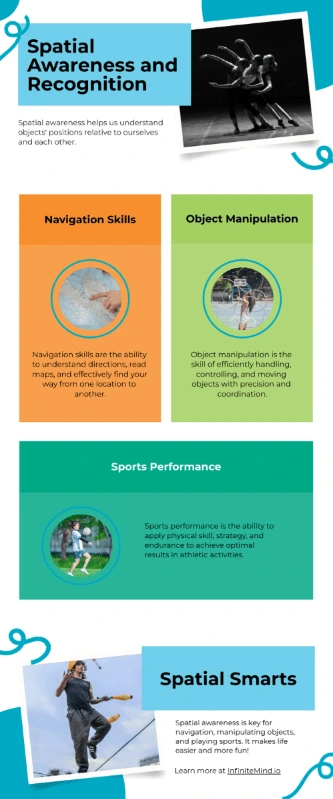
Difficulty with movement and balance → Spatial awareness
Choose the Right Support
Visual puzzles and pattern games
Drawing, building, and mental rotation activities
Map and layout visualization exercises
Track Progress
Observe consistency, not speed
Note improvements in confidence
Revisit similar tasks weekly
Adjust Thoughtfully
Reduce task complexity if frustration increases
Focus on mental visualization before physical execution
Prioritize understanding over completion
Bottom line:
Support the right skill, and progress follows, especially when reading helps the brain reinforce the cognitive patterns that strengthen understanding and long-term learning..
FAQ on Spatial Recognition
Q: What does spatial recognition involve?
A:
Identifying objects and patterns
Remembering spatial layouts
Visualizing space mentally
Organizing visual information
Q: Why is spatial recognition confused with spatial awareness?
A:
They appear similar in daily tasks
They use different cognitive systems
Mental challenges are often mistaken for movement issues
Q: How do spatial recognition difficulties appear?
A:
Trouble with puzzles or diagrams
Difficulty copying shapes or layouts
Problems visualizing space
Errors despite strong effort
Q: Can spatial recognition improve over time?
A:
Yes, it is trainable
Targeted mental practice works best
Improvement is possible at any age
Q: Who should focus on spatial recognition skills?
A:
Children with visual-learning challenges
Students in technical subjects
Anyone struggling with visual organization or navigation
If you’d like, I can also:
Add FAQ schema markup
Optimize for voice search
Align this with InfiniteMind internal linking