For a Black adult in Spokane, that question tends to arrive with another one tucked inside it. You've probably been the only Black person in plenty of rooms already, and a therapy session shouldn't feel like one more.
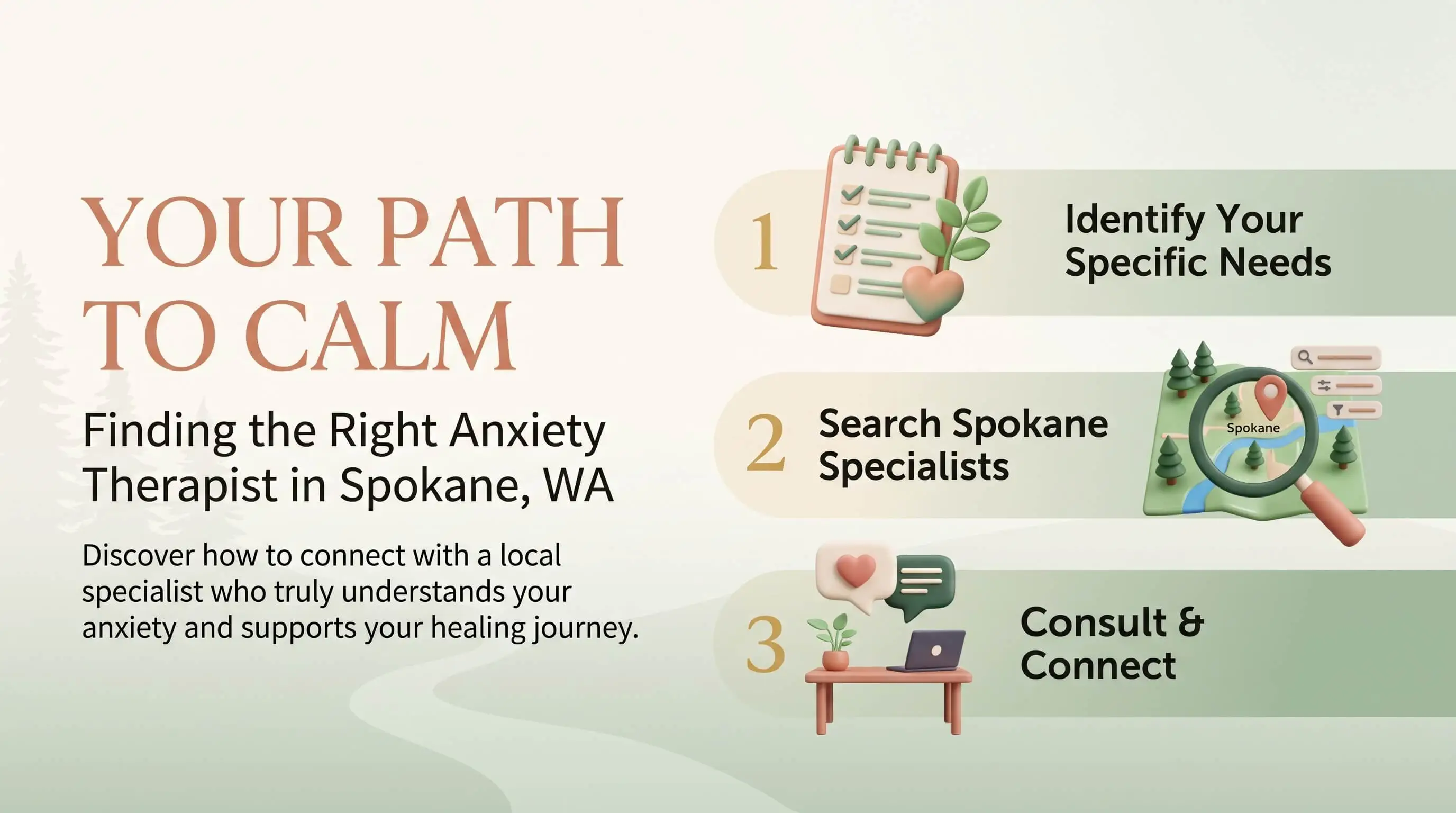
Finding a therapist for anxiety in Spokane, Washington, who gets you comes down to two things you can check before booking anything: how they think about anxiety, and how they respond when your race or family history comes into the room. The practical side, cost and scheduling, is usually easier to sort out than people expect.
You don't have to decide anything today. Read this whenever it suits you and see how it lands.
TL;DR Quick Answers
Therapist for Anxiety in Spokane, Washington
The right therapist for anxiety in Spokane Washington, treats your anxiety as a part of you doing a protective job, and stays curious when race or family comes up. Use a free consultation call to ask direct questions, and widen your search with video sessions open to anyone located in Washington.
Look for: a licensed clinician who gets curious instead of defensive when racism or family pressure comes up
Black-focused directories: Therapy for Black Girls, Therapy for Black Men, and BEAM's Black Virtual Wellness Directory
Local support: NAMI Spokane, plus Frontier Behavioral Health, which accepts Medicaid
One Spokane option: Lauren Rath, MA, LMHC, uses Internal Family Systems (IFS) therapy by video and offers a free 15-minute consult
Ask on the call: their experience with Black clients and what happens if the fit is wrong
Verify first: look up any license on the Washington State DOH Provider Credential Search
In a crisis: call or text 988
Top Takeaways
"Gets you" can mean a shared background, cultural responsiveness, or both. You decide which matters most to you.
Spokane's small Black community makes local matches harder. Statewide video therapy and national directories widen the field.
Anxiety often looks like holding everything together. That anxious part is usually protecting something.
A free consultation call is your best vetting tool. Six direct questions reveal more than any profile.
Switching therapists is normal. If you feel unseen, keep looking until someone fits.
What "A Therapist Who Gets You" Really Means
Some people want a therapist who shares their background. That's a fair thing to want, and you never owe anyone an explanation for it.
Others want a clinician of any background who gets curious instead of defensive when racism comes up, someone who hears what you've lived through as information rather than overreaction.
Being misread costs more than a wasted hour. A therapist might call your anxiety attitude, or read the watchfulness you learned in rooms where you had to be careful as paranoia. After one session like that, most people quietly stop going, and they leave convinced therapy isn't for them when the problem was the fit all along.
Why the Search Can Feel Harder in Spokane
Spokane is Washington's second-largest city and the hub of the Inland Northwest, yet only about 3% of the people who live here are Black. That number shapes who ends up in the therapist's chair.
Local clinicians who share your background are few, and the ones who do often keep a waitlist. Many Black residents of Spokane County already know the feeling of being the only one at work or at a parent-teacher night on the South Hill.
Your search doesn't have to stop at the city line. Washington licenses therapists statewide, which means a clinician in Spokane, Tacoma, Olympia, or Seattle can see you by video as long as you're located in Washington.
When Anxiety Looks Like Holding Everything Together
Not all anxiety announces itself. Often it looks like the person everyone else leans on.
You answer the email at 10 p.m., pick up the shift nobody wanted, check on your mother during the drive home, and keep your face steady through all of it. At some point you learned that strength wasn't optional and that toughing it out was the plan.
People sometimes call this high-functioning anxiety. Clinicians don't diagnose it, but the pattern is easy to recognize once you see it. Your thoughts start racing before the alarm goes off. Rest never quite settles in. A conversation from Tuesday plays on a loop at midnight while you search for the exact moment it went wrong. And under all of it sits a quiet certainty that if you slow down, something important will drop. The good news is that prioritizing your wellness can help you find a healthier balance between getting things done and giving yourself permission to rest.
That part of you isn't your enemy. It has done a hard job for years, usually for reasons that made complete sense when it started.
A Different Way In: IFS and Telehealth Across Washington
Most anxiety treatment focuses on managing symptoms, slowing the breath and questioning the thought. Those tools work, and plenty of good therapists rely on them. On their own, though, they sometimes can't reach far enough.
Internal Family Systems, usually shortened to IFS, works one layer down. It starts from the idea that everyone carries different parts, like one that worries and another that keeps pushing no matter how tired you get. Rather than fighting the anxious part, you get to know it, and once it feels understood, it usually stops working so hard. An IFS therapist Washington state residents can turn to uses this approach to help people better understand these different parts of themselves.
If that approach appeals to you, working with a therapist for anxiety in Spokane who uses IFS by video is worth exploring. Sessions from home mean no drive across town and no chance of bumping into your neighbor in a waiting room.
Six Questions to Ask on a Free Consultation Call
Most therapists offer a short free call before you commit. Treat it as your interview, because those few minutes tell you more than any profile can.
Have you worked with Black clients, and what has that work taught you? Listen for specifics. Reassurance on its own doesn't tell you much.
What happens if racism or family expectations come up in session? Notice whether the answer sounds welcoming or nervous.
How do you work with anxiety? A good therapist can explain their approach in plain words.
Do you offer video sessions, and where do I need to be? In Washington, that answer opens up a lot more options.
Which insurance plans do you take, and what will I pay? Ask now, before anything gets scheduled.
What if we're not a good fit? The best answer is some version of "I'll help you find someone who is."
Signs the Fit Is Right, and When to Keep Looking
A few sessions in, notice how you feel walking out, even more than what anyone said.
Good signs: you feel heard without over-explaining, and your therapist asks before assuming.
Signs to keep looking: you spend sessions educating them, they brush past your experiences, or the dread before each appointment never eases.
Switching therapists is an ordinary part of finding care, and plenty of people try two or three before one fits.
"In years of this work, I have never met a client whose anxiety stopped making sense once we found out what it was protecting. The shift usually arrives the first time someone turns toward that worried part with something other than frustration."
7 Essential Resources
You don't have to search one profile at a time. These seven places can narrow your list or steady you while you wait for an opening.
1 · Search a Directory Built for Black Women
Therapy for Black Girls keeps a searchable directory of clinicians who work with Black women and girls, and many of them offer video sessions. If you'd rather ease in first, the site also has a getting-started guide.
Source: Therapy for Black Girls · Find a Therapist
2 · Find Care Built for Men of Color
Therapy for Black Men lets you search therapists and coaches by location and specialty. It serves men of color, including the many who grew up hearing that strength meant keeping everything inside.
Source: Therapy for Black Men
3 · Browse the Black Virtual Wellness Directory
BEAM, the Black Emotional and Mental Health Collective, runs a directory of Black therapists and wellness practitioners and shares free wellness tools on its site. Try it when the local list runs thin.
Source: BEAM · Black Virtual Wellness Directory
4 · Get Local Support While You Search
NAMI Spokane offers support groups and classes, all led by people who have been there themselves. Staff at its downtown office on South Jefferson Street can also point you toward care nearby.
Source: NAMI Spokane
5 · Use Spokane's Community Mental Health Center
Frontier Behavioral Health, a nonprofit provider, serves adults across Spokane and accepts Medicaid. When cost is the thing holding you back, start with them.
Source: Frontier Behavioral Health
6 · Check Any Therapist's License Yourself
The Washington State Department of Health lets anyone look up a provider's credential and disciplinary record by name. Run the search on any therapist you're considering. Good ones won't mind.
Source: Washington State DOH · Provider Credential Search
7 · Keep a Lifeline for the Hardest Nights
The 988 Suicide and Crisis Lifeline answers calls, texts, and chats 24 hours a day, free and confidential. Keep it close for the nights between sessions, when waiting a week feels too long.
Source: 988 Suicide & Crisis Lifeline
These seven resources can help address hеаlth disparities in mental health care by connecting people in Spokane with culturally responsive therapists, affordable treatment options, community support, and trusted services when they need them most.
Supporting Statistics
Three numbers explain why finding the right fit can take extra effort, and why that effort pays off.
1 · Fewer Than Half of Black Adults With a Mental Illness Get Treatment
In 2025, 40.5% of Black adults with any mental illness received mental health treatment in the past year, compared with 50.9% of U.S. adults overall.
Need doesn't explain the gap. Black adults reported mental illness at a lower rate, 17.2%, than adults overall at 20.6%.
Even among Black adults with serious mental illness, only 58.8% received treatment.
If you've been handling this on your own, you're in a large company. The barrier is access, and access is something you can work around.
Source: SAMHSA · 2025 National Survey on Drug Use and Health, Table 6.21B, as compiled by the Black Health Data Hub
2 · Black Psychologists Are Scarce Nationwide
As of 2016, the latest year in the American Psychological Association's workforce study, 4% of active U.S. psychologists were Black.
About 12% of the U.S. population was Black that same year.
That gap means many Black clients will work with a therapist from a different background. It's also why the consultation questions above carry so much weight, since you can screen for cultural responsiveness on a short call.
Source: American Psychological Association · Demographics of the U.S. Psychology Workforce (2018)
3 · Spokane's Black Community Is Small
Spokane had an estimated 230,783 residents as of July 1, 2025, and about 3.0% identified as Black alone.
Roughly 79.8% identified as white alone.
With numbers like these, a local therapist who shares your background can be hard to find. Statewide video sessions and national directories widen the circle considerably.
Source: U.S. Census Bureau · QuickFacts: Spokane city, Washington
Final Thoughts
Here's where this guide lands, and it runs against the usual advice: you're allowed to interview a therapist the same way they assess you.
Most guidance about starting therapy casts the client as the one under review. You fill out the intake and hope it works. Fit, though, is the biggest factor you control, and you can test for it before you spend a dollar or a single hard hour.
Two things tend to matter more than people expect.
Curiosity counts for more than a matching checklist. A therapist who asks good questions about your world will usually serve you better than one who simply says they understand it.
A rough first session tells you about that pairing. Walking out feeling unseen gives you information about the fit, and it says nothing final about whether therapy can work for you.
A caveat, in fairness. No therapist can guarantee an outcome, and anyone who promises one deserves a second look. What a good therapist can offer is to take you seriously from the first call.
Your anxiety has spent years trying to protect you, and it deserves someone willing to listen.
Frequently Asked Questions
Q: How do I find a therapist for anxiety in Spokane, Washington, who understands me?
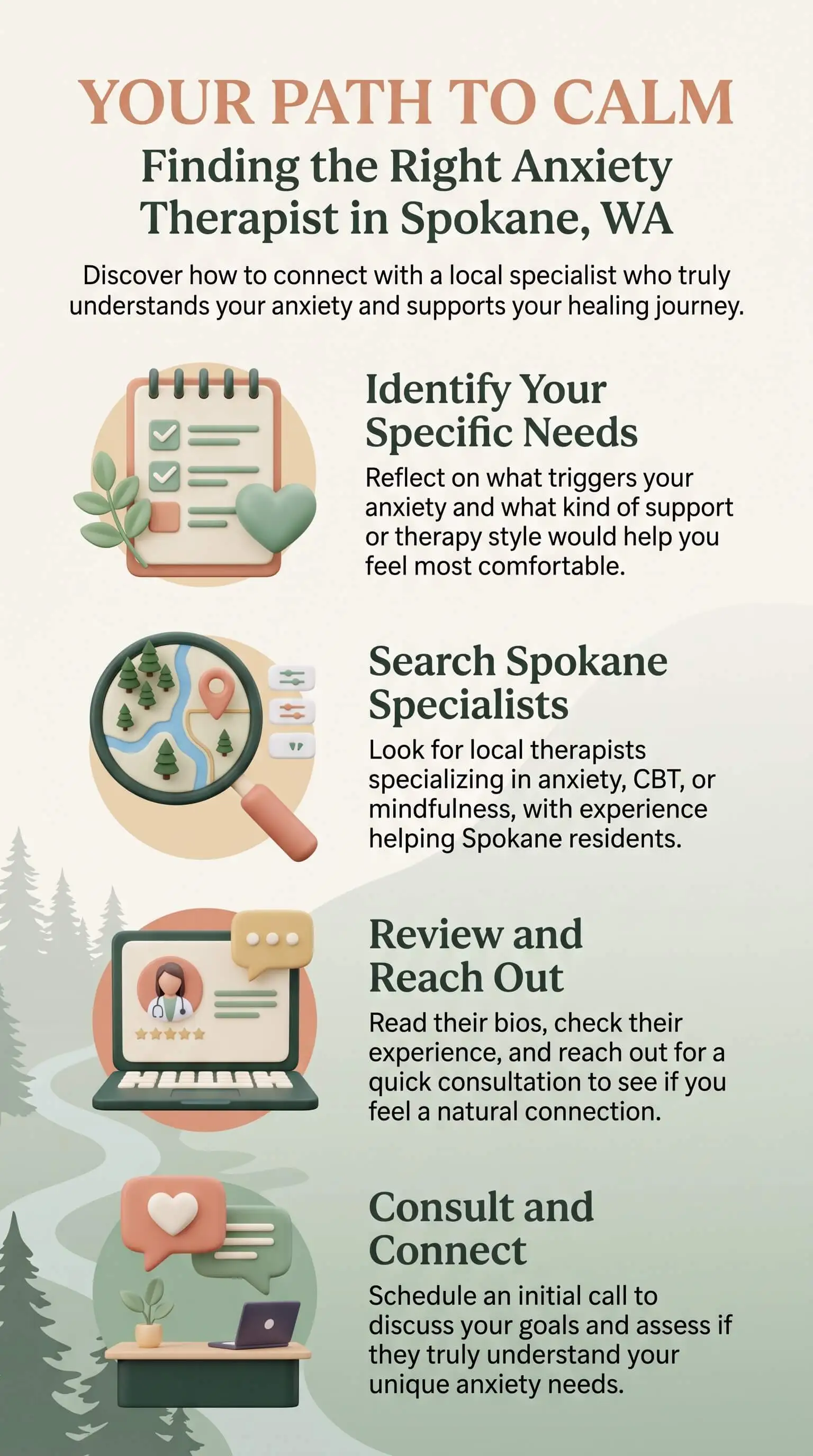
A: Decide first what "understands me" means to you, whether that's a shared background or a therapist who's at ease when race and culture come up. Then search local and Black-focused directories and book two free consultation calls. How you feel after each call is the most honest information you'll get.
Q: How can I find a Black therapist in Spokane?
A: Local options are limited, so look wider. Therapy for Black Girls, Therapy for Black Men, and BEAM's Black Virtual Wellness Directory all list clinicians who offer video sessions, and any Washington-licensed therapist can work with you while you're in the state.
Q: Does my therapist need to share my background to help me?
A: Not always. Many people do well with a therapist from a different background who stays curious and comfortable when race comes up. Others feel safer with someone who shares their experience. Both preferences are valid, and you get to choose.
Q: What should I ask before booking a first session?
A: Start with their experience with Black clients and how they respond when racism comes up in session. Then ask the practical questions about video sessions, insurance, cost, and what happens if the fit is wrong. Clear, unhurried answers are a good sign.
Q: Can I see a Spokane therapist online from elsewhere in Washington?
A: Yes. A therapist licensed in Washington can generally see clients by video anywhere in the state, so a Spokane clinician can work with you in Tacoma or the Tri-Cities, and the reverse holds too.
Q: Will insurance cover anxiety therapy?
A: Most health plans include mental health coverage, though details vary by plan. Ask each therapist which insurers they're in-network with before you schedule, then call your plan to confirm your company. If cost is the barrier, Frontier Behavioral Health in Spokane accepts Medicaid.
Q: What is IFS therapy, in plain terms?
A: Internal Family Systems rests on the idea that everyone has different parts, like a part that worries and a part that pushes hard. Rather than fighting the anxious part, you get to know it, and anxiety often eases once that part feels understood.
Q: What if I need help tonight?
A: Call or text 988, or chat at 988lifeline.org, at any hour. It's free and confidential. If you're in immediate danger, call 911.
Whenever You're Ready
You don't have to keep carrying this alone, and the first step can be a small one. Jot down two names from the resources above along with the six questions, then book one free consultation call this week. If IFS therapy interests you, consider asking about it during the call. The right therapist for anxiety in Spokane, Washington, is the one who leaves you feeling heard, and you're allowed to keep looking until you find that person.