Internal Family Systems (IFS) treats the mind as a group of “parts,” each one trying in its own way to protect you, with a calm, steady core called the Self underneath. It helps a lot of people. It’s also not the right first step for everyone – and understanding who IFS therapy is for and who it may not suit is an important part of deciding whether it’s the right approach.
TL;DR Quick Answers
Who Is IFS Therapy For? (And Who It May Not Suit)
IFS therapy is for adults who understand their patterns but can’t seem to change them, especially when a harsh inner critic, old relationship reactions or a lifetime of being “the strong one” keeps running the show. It may not suit people in crisis, experiencing psychosis or needing stabilization first.
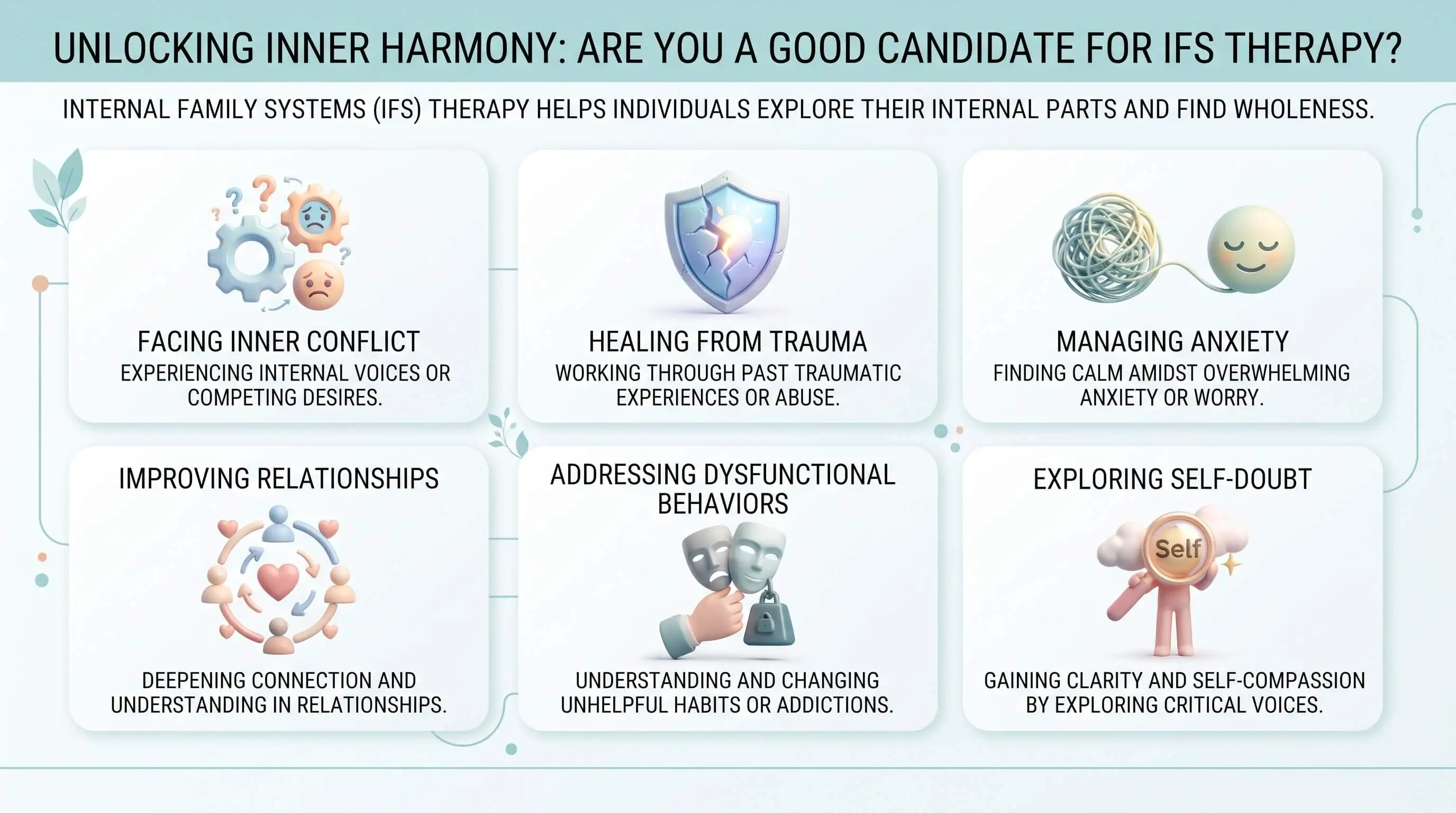
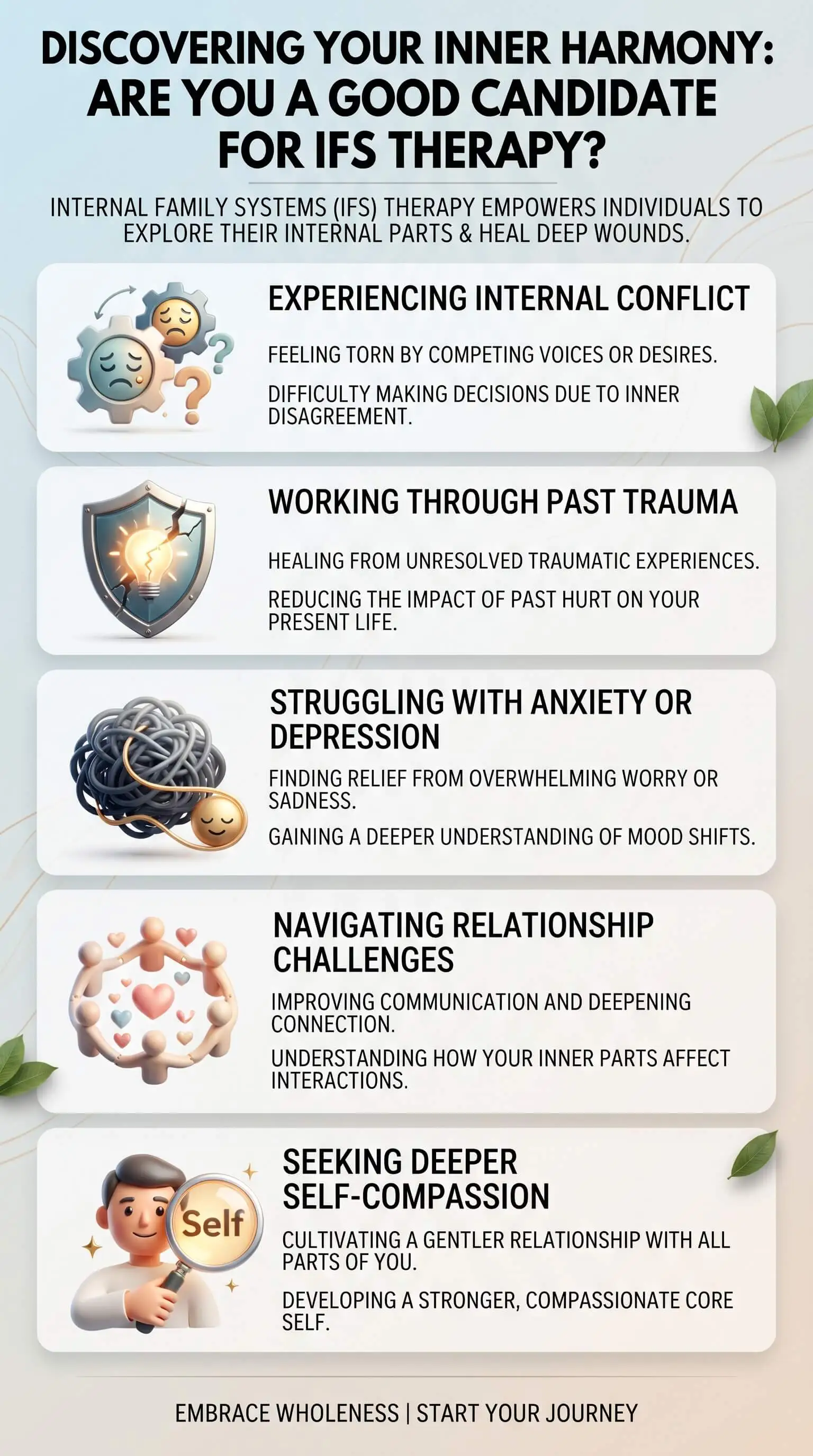
Often a good fit:
Inner conflict you’d describe as “part of me…”
A loud inner critic or perfectionism
Relationship patterns that keep repeating
Insight that hasn’t turned into change
Past talk therapy that stalled
Usually not the first step:
Active crisis or uncertain safety (call or text 988)
Psychosis, paranoia or schizophrenia
Early, active substance use
A strong preference for worksheets and homework, where CBT or DBT may fit better
Turning inward still feels overwhelming
Bottom line: IFS treats every part as protective, even the ones that feel like problems. For people who aren’t ready yet, the answer is usually “not yet” rather than “never,” and a free consultation is the quickest way to find out where you stand.
Top Takeaways
IFS sees the mind as a set of protective parts led by a calm core Self, and no part is treated as bad.
Good candidates often feel divided inside, live with a harsh inner critic, repeat old relationship patterns or found that earlier talk therapy stalled.
IFS may not be the right first step during a crisis, with psychosis, in early active substance use or when structured skills need to come first.
The research is promising but young, with the strongest results so far for depression and self-compassion.
Cultural fit matters as much as method, so ask about training, experience with Black clients and online options before you commit.
What IFS Therapy Is, in Plain Words
Psychologist Richard Schwartz developed IFS in the 1980s around a simple premise: nobody has just one mind. One part of you plans and pushes, another numbs out when things get heavy, and somewhere further back a younger part is still holding an old hurt. Underneath all of them sits the Self, the part of you that can stay curious and kind even when the others can’t.
IFS sorts parts into three loose groups:
Managers try to stop pain before it starts, through planning, people-pleasing, perfectionism or simply staying busy.
Firefighters rush in when pain breaks through anyway. Think 2 a.m. scrolling, one more drink or shutting down halfway through an argument.
Exiles carry the older hurt the other groups work so hard to guard.
IFS doesn’t cast any part as the villain. It treats even the harshest inner critic as a part that once had a good reason to show up. And you don’t need to memorize any of this... a good IFS therapist will meet you in plain language.
Signs You May Be a Good Candidate for IFS Therapy
IFS tends to help adults who feel divided inside, who understand their patterns but can’t seem to shift them, or whose old reactions keep running new situations. Spokane-based IFS therapist Lauren Rath, MA, LMHC, has written a candid breakdown of who IFS therapy is best for, including the people she’d point toward a different starting place. The signs below are the ones that show up most.
You Feel Pulled in Different Directions
“Part of me wants to leave this job, and part of me is terrified to.” If that sentence could have come out of your mouth, you’re already thinking in parts. IFS gives the inner tug-of-war some structure. Rather than forcing one side to win, you get to find out what each side is afraid of.
You Understand Your Patterns but Can’t Change Them
Plenty of people can explain exactly why they shut down or overcommit, and they still do it. That gap between knowing and changing is where IFS tends to earn its keep. The work is experiential, so much of a session happens inside you, in your attention and your body, rather than in talking about the problem from a safe distance.
Your Inner Critic Never Lets Up
Try arguing with your self-criticism and you’ll probably notice it argues back harder. IFS gets curious instead and asks what that critic is trying to protect you from. If that voice sounds familiar, our piece on whether you can reframe negative thoughts makes a good companion read.
Old Reactions Keep Showing Up in New Relationships
Wanting closeness, then pushing people away. Going quiet the second someone raises their voice. Reactions like these often started early, even in childhoods that looked “normal” from the outside. IFS helps you meet the younger part that’s still reacting and let it know the danger has passed.
You’ve Always Had to Be “the Strong One”
For many Black adults, being strong was never optional. It was how families got through hard seasons: keep problems in the house and don’t let anyone see you struggle. Those are protective parts doing a real job, and IFS doesn’t ask you to throw them out. It asks them, respectfully, what they’d need in order to rest.
That can feel a lot safer than an approach that seems to treat strength as a symptom. Our article on mental health stigma in the Black community goes deeper on why asking for help can feel so loaded.
Talk Therapy Helped, but Not All the Way
Maybe you came away from therapy with coping skills and better words for your feelings, while the heaviness underneath stayed put. Lauren names this group directly on her own site: people who have done therapy and felt nothing move. None of that is a knock on your last therapist. Sometimes a different door opens a different room.
Good Fit vs. Starting Somewhere Else
Often a good fit for IFS:
You feel conflicting things and can name them as “a part of me”
A harsh inner critic or perfectionism runs your days
The same relationship patterns keep repeating
You have insight that hasn’t turned into change
Past trauma, anxiety or low mood still weighs on you
Earlier talk therapy stalled
Consider starting elsewhere first:
You’re in crisis or your safety is uncertain (call or text 988)
You’re experiencing psychosis, paranoia or schizophrenia
Substance use is active and in its early stages
You strongly prefer worksheets and homework (CBT, DBT)
Turning inward overwhelms you right now
The main issue centers on a partner’s or parent’s behavior
Who IFS Therapy May Not Suit (and Where to Start Instead)
IFS may not be the right first step if you’re in crisis, experiencing psychosis, early in active substance use, or needing structured skills before going inward. In most of these cases the answer is “not yet” rather than “never,” and plenty of people come back to IFS once they have steadier ground under them.
You’re in crisis or your safety is uncertain. Immediate support comes first. Call or text 988, the Suicide and Crisis Lifeline, any time of day.
You’re experiencing psychosis, paranoia or schizophrenia. Psychology Today notes that describing a person as having “parts” may be unproductive or even harmful in these cases.
Substance use is active and early. Stabilizing first, often with a model built for addiction care, usually makes later parts work safer.
You want worksheets, homework and clear steps. CBT or DBT may suit you better, at least at the start.
Turning inward floods you right now. IFS asks you to stay with your inner experience for long stretches. If that’s overwhelming, some groundwork comes first.
The core struggle is someone else’s behavior. When the main problem centers on a partner or parent, individual IFS has limits, and couples or family work may help more.
You don’t have to sort this out on your own. A free consultation call with a trained therapist is built for exactly this question.
What the Research Actually Says
IFS research is promising and still young. Depression shows the strongest signal so far. Even the model’s own institute says bigger trials are still needed.
The IFS Institute’s own research summary lists a 2013 randomized controlled trial in the Journal of Rheumatology as the first to test IFS on patient outcomes. People with rheumatoid arthritis in that trial reported less pain and fewer depressive symptoms, along with better physical function and more self-compassion. Depression is the only condition so far with statistically significant improvement across multiple pilot randomized trials. And in 2026, researchers published what the Institute describes as the first randomized controlled trial of a group-based, online IFS program for PTSD.
The Institute is just as upfront about what isn’t known. By its own account, IFS isn’t yet established as an evidence-based intervention for specific mental health conditions, and nobody has systematically studied the risk of adverse effects. I find that honesty reassuring. Anyone promising IFS will fix everything on a set timeline is selling something.
IFS and Cultural Fit: What Black Clients Can Ask For
The method matters, and so does the person across from you (or on the other side of the screen). A good fit means a therapist who respects your culture, doesn’t read strength or caution as a disorder, and talks openly about their training.
Black adults are underrepresented on both sides of the therapy room, as the numbers further down show. That makes a few direct questions on a consultation call worth asking:
What IFS training have you completed?
How do you work with stress shaped by racism, family expectations or faith?
Have you worked with Black clients before, and what did you learn from it?
What happens if a part of me doesn’t trust you yet?
Do you offer online sessions?
That last question carries more weight than it looks. So much of IFS happens internally that it translates well to video, and online sessions widen your options beyond whoever happens to practice in your zip code, as long as the therapist is licensed in your state. In Washington, our guide to finding a therapist for anxiety in Spokane covers what to look for locally.
A Quick Self-Check: Is IFS Right for You?
Answer yes or no to each:
I often feel two or more ways about the same thing.
My inner critic is loud and hard to quiet.
I understand my patterns but still repeat them.
In some situations I react like a much younger version of myself.
I’ve tried therapy before and felt stuck.
I’m curious about my inner world, even if it feels unfamiliar.
I’m currently safe and not in crisis.
I can sit with hard feelings for a while without being overwhelmed.
If most of your answers were yes, including 7 and 8, IFS is worth a consultation. If 7 or 8 is a no, start with stabilizing support and keep IFS on your list for later.
“I’ve watched clients who can explain every one of their patterns still feel stuck in them. That gap between knowing and changing is where IFS earns its place. But I don’t take every case, and I’d never promise a timeline. If someone is in crisis or doesn’t feel steady yet, the kind thing is to say ‘not yet’ and point them somewhere safer first. The parts that resist therapy usually aren’t the problem. They’re protecting something, and they deserve to be asked what.”
7 Essential Resources
1. IFS Institute Research Summary
The model’s home organization lists the studies to date, what each one found and where the evidence is still thin. Start here if you want facts before you commit. ifs-institute.com/resources/research
2. IFS Institute Practitioner Directory
Search IFS practitioners by location, training level, certification and availability. The Institute doesn’t independently verify the credentials providers report, so ask about training directly on your first call. ifs-institute.com/practitioners
3. Therapy for Black Girls
A “Find a Therapist” directory, plus a podcast and blog centered on the mental health of Black women and girls. therapyforblackgirls.com
4. Therapy for Black Men
A directory built to help men of color, particularly Black men, find multiculturally competent therapists and coaches by location and specialty. therapyforblackmen.org
5. BEAM (Black Emotional and Mental Health Collective)
A national nonprofit with a wellness directory, a psychiatric care guide, monthly healing circles and practical mental health tools. beam.community
6. 988 Suicide and Crisis Lifeline
Free, confidential support around the clock for emotional distress, mental health crises, and alcohol or drug concerns. Call or text 988, or chat online. 988lifeline.org
7. FindTreatment.gov
SAMHSA’s federal locator for state-licensed care, covering mental health and substance use conditions including PTSD, depression and serious mental illness. findtreatment.gov
These seven resources can help you understand who IFS therapy is for, find qualified mental health professionals, and explore accessible support options that address hеаlth dіspаrіtіеs and barriers to appropriate mental health care.
Supporting Statistics
Most Adults Carry at Least One Childhood Adversity
The CDC reports that 61 percent of U.S. adults had at least one adverse childhood experience, and 16 percent had four or more. Several racial and ethnic minority groups faced a greater risk of four or more. Childhood stress doesn’t always look dramatic from the outside, and IFS is built to work with the parts that formed around it.
Fewer Than Half of Black Adults With a Mental Illness Get Treatment
In 2025, 40.5 percent of Black adults with any mental illness received mental health treatment in the past year, compared with 50.9 percent of U.S. adults overall, according to SAMHSA survey data compiled by Black Health. Need doesn’t explain the gap. Black adults reported mental illness at 17.2 percent, below the national rate of 20.6 percent.
Only About 3 Percent of the Psychology Workforce Is Black
The American Psychological Association reports that 3 percent of the psychology workforce identified as Black, compared with 83 percent who identified as White, based on its Center for Workforce Studies data. That shortage is a big part of why online therapy and culturally focused directories matter so much.
Final Thoughts and Opinion
After a lot of time writing about mental health for this site, my view is simple. Fit matters more than hype.
IFS is having a moment, and some of that attention is earned. Its central idea, that even our most frustrating habits are parts trying to protect us, is a gentle way to look at a life that may have required a lot of armor. I’d still be wary of treating it as the answer for everyone. It looks especially promising for inner conflict, self-criticism and old patterns that insight hasn’t touched. For someone in crisis, someone experiencing psychosis or someone who needs structure first, it’s usually the second stop rather than the first.
For Black readers, I’d add one more thing. The right therapist is part of the treatment, so ask the hard questions and take the free consultation. If a part of you hesitates, listen to it... then bring it along on the call.
Frequently Asked Questions
Who Is IFS Therapy Best For?
IFS tends to work well for adults who feel pulled in different directions, struggle with a harsh inner critic, keep repeating the same relationship patterns or have done talk therapy without lasting change. It also suits people who are curious about their inner world and want more than insight on its own.
Who Should Not Do IFS Therapy?
IFS may not be the right starting point for people in active crisis, people experiencing psychosis or schizophrenia, those early in active substance use, or anyone who can’t yet turn inward without feeling overwhelmed. In many of these cases, stabilizing support comes first and IFS can follow later.
Is IFS Therapy Good for Trauma and PTSD?
Many therapists use IFS for trauma, and the research is growing. A 2026 randomized controlled trial tested a group-based, online IFS program for PTSD. The evidence base is still young, though, so look for a therapist with solid trauma training alongside their IFS work.
Can IFS Help With Anxiety or Depression?
For many people, yes. Depression shows the strongest research signal so far, with improvement across multiple pilot trials. Anxiety often responds well too, since anxious thoughts are frequently protective parts working overtime. IFS helps you get curious about them rather than fight them.
Is IFS Therapy Evidence-Based?
Not fully, at least not yet. The IFS Institute says IFS isn’t yet established as an evidence-based intervention for specific mental health conditions and that larger trials are needed. Early studies are encouraging, especially for depression, self-compassion and pain linked to rheumatoid arthritis.
Do I Have to Believe I Have “Parts” for IFS to Work?
No. Most people already say things like “part of me wants this,” and IFS simply takes that everyday language seriously. You don’t need to adopt the vocabulary. If a part of you is skeptical, a good therapist will welcome that part too.
Does Online IFS Therapy Work as Well as In-Person?
For many people, it does. IFS happens mostly inside your own awareness, so it translates well to video sessions. Online therapy can also widen your choice of therapists, though you’ll need someone licensed in the state where you live.
How Do I Find a Culturally Responsive IFS Therapist?
Start with the IFS Institute practitioner search, Therapy for Black Girls, Therapy for Black Men and BEAM. On a consultation call, ask about IFS training, experience with Black clients and how the therapist handles stress shaped by racism or family expectations.
Whenever You’re Ready
If something here feels familiar, pay attention to that. Washington residents can book a free, 15-minute, no-pressure consultation with Lauren Rath Therapy to talk through whether IFS fits. She works with adults virtually across the state. Outside Washington, the directories above are a good place to begin.